
AI LEAD INTAKE FOR Mental Health Practices
Every referral, understood before you call.
Bowr sits on your practice website and conducts gentle, trauma-informed intake conversations 24/7, understanding the presenting concern, funding pathway, and urgency, and sending you a structured brief the moment the conversation ends.
The problem
Clients reach out at their most vulnerable.
Not hearing back is deeply discouraging.
People reach out at a moment of courage, and need a response
Reaching out to a mental health practitioner is hard. Someone who finally sends an enquiry is taking a significant step. When they hear nothing for days, many don't follow up. They convince themselves it wasn't necessary. The window closes.
Directory leads are drying up
Psychology Today and similar directories have become more competitive and less reliable. Your own website is your most valuable asset, but only if it can capture and respond to enquiries intelligently.
Your contact form can't handle sensitive situations
Name, email, 'I'd like to make an appointment.' That tells you nothing. And for a mental health practitioner, knowing the presenting concern, urgency, and preferences before a first call is essential, for your practice and for the client.
After-hours is when people reach out
Someone decides on a Sunday evening that they're ready to seek help. They find your website. Your contact form collects their email. They receive nothing. By Monday they've talked themselves out of it.
How Bowr Works
A conversation that qualifies, not interrogates.
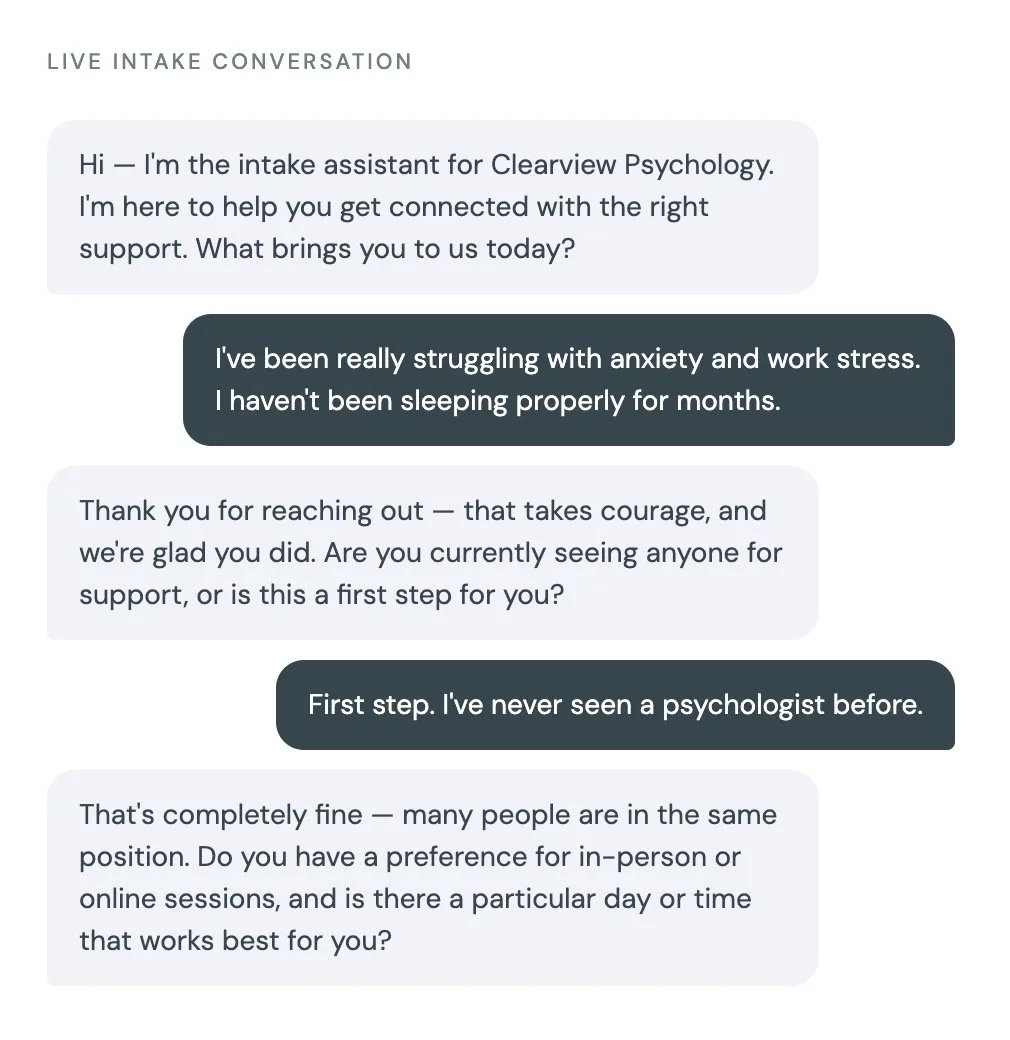
Visitor starts a conversation
Bowr introduces itself as your intake assistant, not a chatbot. It greets the visitor warmly, in your brand's tone and voice.
AI infers the enquiry type
Within the first response, Bowr understands what the visitor needs and asks intelligent follow-up questions scoped to your services.
Enquiry is qualified and scored
Bowr scores urgency, fit, and lead temperature. Out-of-scope enquiries are redirected gracefully. Only the right ones progress.
Brief sent to your phone instantly
The moment the conversation ends, you receive an SMS and email, who they are, what they need, urgency, and a recommended action.
Built for MENTAL HEALTH PRACTICES
Bowr knows what it won't do.
For mental health practitioners, this matters deeply. Bowr is designed around intake, not clinical guidance. It will never diagnose, recommend treatment, or advise on medications. Crisis responses follow safe messaging protocols. That protects your practice and builds visitor trust.
Never provides clinical assessment or therapeutic advice
Bowr is trained for intake only, it won't assess clinical presentations, recommend treatment approaches, offer therapeutic guidance, or comment on diagnoses. All clinical matters are handled by the practitioner.
Handles distress and vulnerability with exceptional care
Bowr is specifically trained to respond with warmth, gentleness, and non-judgement to sensitive mental health enquiries. It never feels clinical, dismissive, or like a screening form.
Stays within your therapeutic scope
You define your practice's specialities and therapeutic approaches. Bowr only qualifies enquiries that match and handles anything outside your scope with appropriate care.
Always provides a clear next step
Every conversation ends with the client knowing exactly what to expect, a callback, an intake form, a first appointment. No client is left uncertain after reaching out.
The cost of doing nothing
Your website attracts enquiries.
Your intake process loses them.
The bowr comparison
You’ve tried the rest.
Now try the best.
The intake brief
Know the presenting concernbefore you reach out.
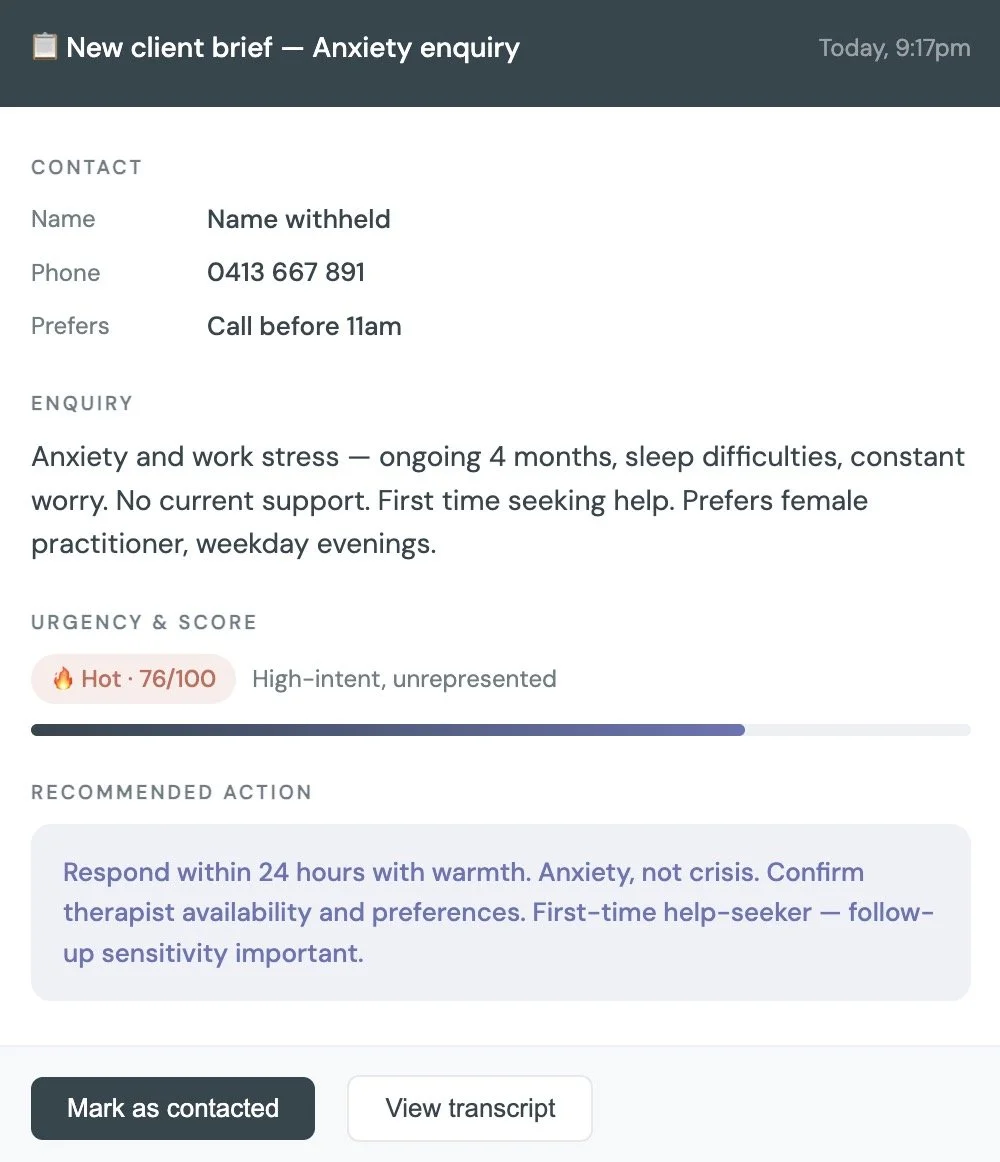
Every completed intake generates a full structured brief, delivered to your phone and inbox the moment the conversation ends.
Client name, phone, email — captured during intake
Presenting concern — what brought them to you, in their words
Urgency & distress level — ongoing, acute, or stable
Preferences — gender, modality, in-person vs online, timing
Lead temperature & score — readiness to engage
Recommended action — priority response, standard, or referral
Full transcript— every message saved sensitively
Pricing
One AI intake agent.
Every referral understood before you call.
One AI intake agent on your website. Qualified leads in your inbox before you call. No lock-in.
30-day free trial · No credit card required · Cancel any time

FAQS
Questions about Bowr for mental health practitioners
-
Crisis detection is built into the mental health intake flow. If a visitor discloses thoughts of self-harm, suicide, or harm to others, Bowr will immediately provide crisis support resources, including Lifeline and Beyond Blue, and flag the conversation for urgent human follow-up. It will not continue a standard intake conversation in a crisis scenario. This follows safe messaging guidelines.
-
Never. Bowr is an intake agent, not a clinician. It will never interpret a visitor's situation therapeutically, recommend a treatment approach, diagnose a condition, or provide any form of clinical guidance. Its role is to understand why someone is seeking support, what funding pathway may apply, and how urgently, and deliver that to you as a brief before you call.
-
Bowr will ask whether a visitor has a current Mental Health Treatment Plan from their GP and, if not, whether they are aware they may need one to access Medicare rebates. It does not assess eligibility, that remains with the clinician, but it captures the referral status so you know what to prepare for the first session.
-
Yes. The mental health intake flow is trauma-informed in its language, warm, non-clinical, and non-pressuring. It does not use diagnostic language, does not ask visitors to categorise their condition, and does not feel like a medical form. The tone is set to be reassuring and human from the first message.
-
Yes. Bowr will ask about NDIS plan status for visitors who indicate they are seeking NDIS-funded support. It captures plan management type, self-managed, plan-managed, or NDIA-managed, and whether a support coordinator is involved. This gives you the context you need before the first appointment without putting the burden on the visitor to know all the details upfront.